Sign Up & Get Rs.5,000 OFF On Your First Purchase




Queen-size Bed Dimensions Explained: Finding the Right Fit for Your Bedroom
10 Aug 2026
Buying a queen bed sounds simple until you realise that numbers vary by brand, region, and even product listing. Queen-size bed dimensions follow a standard format, yet small variations can mean your mattress hangs over the frame or your fitted sheet pops off at 2 AM.
The standard measurement sits at 60 inches by 80 inches, or 152 by 203 centimetres.
Getting these figures right affects more than just bedding purchases. You need proper clearance around the bed for walking, opening drawers, and placing bedside tables.
This article covers global variants, room layout rules, a 2026 buying checklist, and practical fit guidance. No guesswork, just clear answers.
What are the Standard Queen-Size Bed Dimensions?
The core measurement for a queen bed is 60 inches wide and 80 inches long. This translates to 5 feet by 6.67 feet, or 152 centimetres by 203 centimetres. These numbers have remained consistent across manufacturers for decades.
📏 Inches
- Width: 60 inches
- Length: 80 inches
---
👣 Feet
- Width: 5 ft
- Length: 6 ft 8 in
---
📐 Centimetres
- Width: 152 cm
- Length: 203 cm
Mattress thickness adds another layer to consider. Most queen mattresses range from 9 to 12 inches thick, affecting overall bed height and how sheets fit.
Bed frames typically extend 2 to 3 inches beyond the mattress edge on each side. Factor this into your room measurements.
How Queen-Size Bed Measurements Vary by Region
Manufacturing standards shift depending on where the bed was made. This creates dimension variations that can ruin your bedding purchases or leave gaps between the mattress and the frame. Here is how queen-size bed measurements in cm and inches differ across regions:
Check-out Queen Size Beds Collection at Pepperfry --->
US and Canada:
- Width: 60 inches (152 cm)
- Length: 80 inches (203 cm)
- Most consistent standard globally
UK and Europe:
- UK Queen: 60 inches by 78 inches (152 cm by 198 cm)
- European Standard: 160 cm by 200 cm
- Note: Europeans often label 160 by 200 cm as "King," causing confusion
India and Asia-Pacific:
- Width: 60 inches (152 cm)
- Length: 78 inches (198 cm)
- Two inches shorter than the US standard
Tip: Always verify retailer listings before purchasing imported mattresses or bedding sets to ensure you're getting the best quality. A bedding set labelled "queen" from an overseas brand may not fit your locally purchased frame.
Comparing Queen-Size Bed Dimensions to Other Bed Sizes
Understanding where a queen fits among other sizes helps you gauge if it suits your needs. The table below compares common bed types:
🛏️ Double/Full Bed
- Dimensions: 54 × 75 inches (137 × 190 cm)
- Space Per Sleeper: 27 inches
- Cost Tier: Budget
---
🛏️ Queen Bed
- Dimensions: 60 × 80 inches (152 × 203 cm)
- Space Per Sleeper: 30 inches
- Cost Tier: Mid-range
---
👑 King Bed
- Dimensions: 76 × 80 inches (193 × 203 cm)
- Space Per Sleeper: 38 inches
- Cost Tier: Premium
---
🌴 California King Bed
- Dimensions: 72 × 84 inches (183 × 213 cm)
- Space Per Sleeper: 36 inches
- Cost Tier: Premium
A queen bed offers 30 inches of sleeping width per person when shared. That is enough for most couples to sleep without elbowing each other.
The queen bed size in feet works well for rooms that cannot accommodate a king-size bed but need more space than a double.
Select a queen if your room width supports adequate clearance and your budget favours value over maximum sprawl.
What Room Size Do You Need for a Queen-Size Bed?
The designer's rule of thumb calls for a minimum room size of 10 feet by 10 feet. This allows 24 inches of clearance on each side for comfortable movement, making the bed, and accessing furniture.
For a 10 by 12 foot room, a typical layout places the queen bed centred against one wall, with space for:
- Two bedside tables (18 to 24 inches wide each)
- A wardrobe on the opposite wall with full drawer clearance
- Clear walking paths of at least 24 inches
Clearance Checklist:
- Minimum 24 inches on each side of the bed.
- Verify door swing paths remain unblocked.
- Ensure wardrobe drawers can fully extend.
- Check window access for cleaning and ventilation.
Try the floor-taping technique before buying. Mark out the queen-size bed dimensions on your floor using painter's tape. Walk around the taped area for a few days. You will quickly notice if the space feels cramped.
"There should be adequate circulation space with a clearance of at least 30 inches on both sides and in front of the bed." - Houzz India
Who Should Choose a Queen-Size Bed?
A queen suits specific living situations better than others. Here are the profiles that benefit most from queen-size bed dimensions:
Ideal for:
- Couples without young children co-sleeping regularly
- Tall single adults wanting extra length beyond a double
- Small-to-medium bedrooms that need maximum sleep surface
Pros:
- Comfortable space for two adults
- Future-proofs your bedroom if your living situation changes
- Strong resale appeal when upgrading later
Cons:
- Larger footprint than twin or full beds
- Higher cost than a standard double
Here is a quick test: Measure your combined shoulder span with your partner. If it exceeds 50 inches, you will appreciate the full 60-inch width. If your room width exceeds 12 feet, consider upgrading to a king for added comfort.
Understanding Frame Overhang and Bedding Compatibility
Bed frames add 2 to 3 inches beyond the mattress dimensions on each side. This affects doorway and staircase clearance during delivery. Measure your narrowest entry point before ordering.
Standard queen bedding sizes work as follows:
- Fitted sheets: 60 by 80 inches with pocket depths of 9 to 14 inches
- Flat sheets: 90 by 102 inches
- Duvets: 88 by 88 inches (square) or 90 by 90 inches
Frame types vary in height and function. Platform frames sit lower and suit modern aesthetics. Storage frames with drawers add 4 to 6 inches of height. Adjustable frames work well with queen bed foldable mattresses for flexible positioning.
Pre-Purchase Checklist:
- Measure headboard height against window sills.
- Confirm delivery path widths (doorways, staircases, lifts)
- Verify mattress thickness works with your chosen frame rails.
Your 2026 Queen-Size Bed Measurement Checklist
Before clicking "Add to Cart," run through every item below. This checklist prevents costly returns and delivery headaches:
- Room dimensions recorded in feet and inches
- Floor-tape visualisation completed
- Staircase width measured (minimum 28 inches for most frames)
- Doorframe widths confirmed
- Lift dimensions checked (apartment buyers)
- Delivery path clearance verified
- Storage bed lift height compared to under-bed space
- 2026 retailer spec sheet cross-referenced
Note: Manufacturers occasionally update tolerances. Always check the specific product listing for the exact queen bed size in feet rather than assuming the standard applies.
Tick every box before finalising your purchase. A few minutes of measuring saves weeks of return processing.
How to Move and Maintain Your Queen-Size Bed?
Getting your bed home and keeping it in good condition requires a few practical steps that most guides overlook:
Moving Tips:
- Always use two people to lift the frame; solo lifting causes warping
- Choose frames with detachable headboards for narrow stairways
- Remove the mattress and bedding before moving the frame
Maintenance Tips:
- Rotate your mattress 180 degrees every three months
- Vacuum under the bed monthly to prevent dust buildup
- Tighten frame bolts every six months
Space-Saving Ideas for 10 by 10 Rooms:
- Platform frames with built-in drawers eliminate the need for a dresser
- Rolling under-bed storage bins keep seasonal items accessible
- Wall-mounted bedside shelves free up floor space
These habits extend your bed's lifespan and maximise your investment over time.
Ready to Choose the Perfect Queen-Size Bed for 2026?
The standard queen-size bed dimensions of 60 by 80 inches, or 152 by 203 centimetres, give most couples and tall individuals the space they need. Regional variations exist, so always verify exact measurements before purchasing imported products.
Stick to the 10 by 10 foot minimum room rule and work through the measurement checklist above.
Measure your space today, verify dimensions on Pepperfry product pages, and proceed knowing your choice will fit perfectly. Your bedroom deserves a bed that works, not one that crowds the room.
Frequently Asked Questions (FAQs)
1. What are the exact dimensions of a queen size bed in feet and inches?
A standard queen size bed measures 60 inches wide and 80 inches long. In feet, that translates to 5 feet by 6 feet 8 inches. Frame dimensions may add 2 to 3 inches on each side.
2. How do queen size bed measurements differ between India and the United States?
Indian queen beds typically measure 60 by 78 inches, while US beds measure 60 by 80 inches. This 2 inch length difference affects mattress and bedding compatibility when purchasing across regions.
3. What is the minimum room size needed to comfortably fit a queen size bed?
A 10 by 10 foot room works as the minimum. This allows 24 inches of clearance on each side for walking, making the bed, and accessing other furniture like bedside tables and wardrobes.
4. Do all queen mattresses have the same thickness?
No. Queen mattress thickness ranges from 9 to 12 inches, depending on the type. Memory foam and pillow top mattresses tend to be thicker than spring mattresses.
5. Will a standard queen size bed fit through a 30 inch doorway?
A queen mattress alone can fit through a 30 inch doorway when tilted. However, assembled frames with headboards may require disassembly. Measure your narrowest entry point before delivery day.
6. Is a queen size bed suitable for sleepers over 6 feet tall?
Yes. The standard 80 inch length provides adequate space for sleepers up to 6 feet 4 inches. Taller individuals may want to test the bed or consider a California King with its 84 inch length.
Show more blogs from :
Bedroom Interior
Recommended For You
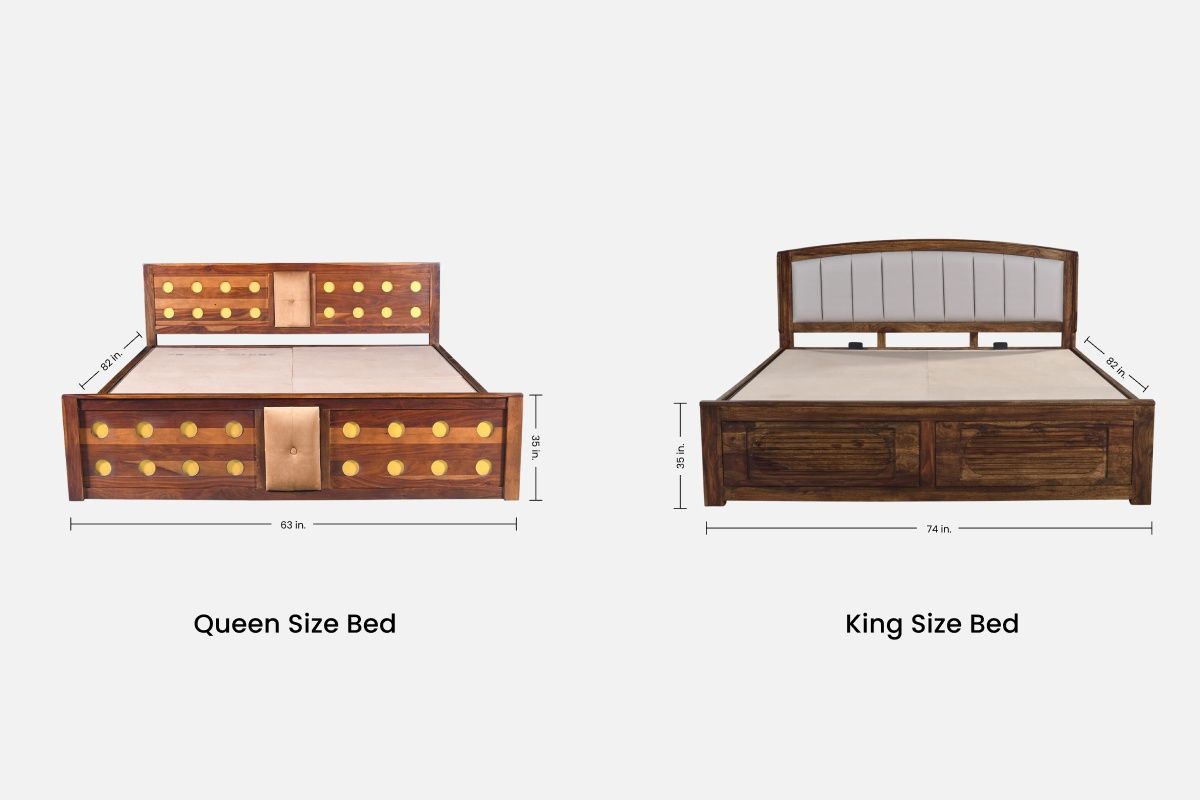
King vs. Queen Size Beds: What's the Difference and Which Should You Choose?
Your bedroom can only fit so much. Yet you want a bed that feels spacious enough for proper rest. This is the core tension when choosing between a king vs queen-size bed.
The difference between king and queen-size bed options goes beyond a simple width number. It affects how you sleep, how your room feels, and what you pay over the years. This article gives you concrete measurements, room-fit rules, and a practical checklist to help you decide with confidence.
King Size vs Queen Size Bed Dimensions: The Numbers That Matter
Here's a quick look at how king-size vs queen-size bed dimensions compare in both inches and centimeters.
📏 Width
Queen Size Bed: 60 inches (152 cm)
King Size Bed: 72 inches (183 cm)
📐 Length
Queen Size Bed: 78 inches (198 cm)
King Size Bed: 78 inches (198 cm)
🛏️ Surface Area
Queen Size Bed: 4,680 sq inches
King Size Bed: 5,616 sq inches
The 12-inch width gap translates to over 900 square inches of extra sleeping surface. That's roughly the size of a large pillow added to your bed. Indian standard bed dimensions align closely with global measurements. Most king-size beds and queen-size beds follow these exact specifications.
Quick Tip: Mattress dimensions and bed frame sizing differ slightly. A king mattress fits a king frame, but some frames add 2-4 inches on each side for headboards and footboards. Always check frame dimensions before ordering.
This matters when measuring your room. The frame footprint, not just the mattress size, determines how much floor space your bed actually occupies.
Check-out Our Beds Collection -->
Difference Between King and Queen Size Bed: More Than Just Width
That 12-inch width difference changes your sleep experience in three clear ways.
- Width per person: On a shared queen, each person gets about 30 inches. Move to a king, and each person gains roughly 6 inches. That's the difference between sleeping shoulder-to-shoulder and having actual breathing room.
- Length options for taller sleepers: Both queen and king beds come in extended 84-inch versions for those over 6 feet tall. Standard lengths work fine for most adults, but tall individuals should look for these longer variants.
- Surface area impact: The extra 900+ square inches on a king bed makes a real difference for couples who co-sleep with children or pets. It means less accidental elbowing and more undisturbed rest.
The king vs queen size bed choice comes down to how much personal space you need whilst sleeping. If you or your partner moves around at night, that extra width reduces disturbances. If you sleep still and close together, a queen often works perfectly well.
"Carefully consider purchases of larger furniture. You may need to move to another house in the future, and large pieces might be difficult to fit in another space."-Houzz
How Much Room Space Do You Actually Need?
Before buying any bed, measure your bedroom carefully. Here's what fits where.
📏 10 × 10 ft Room
Recommended Bed Size: Queen (tight fit)
📏 10 × 12 ft Room
Recommended Bed Size: Queen (comfortable)
📏 12 × 12 ft Room
Recommended Bed Size: King (adequate)
📏 12 × 14 ft Room
Recommended Bed Size: King (comfortable)
The 2-foot walkway rule matters here. You need at least 24 inches of clear space on each side of the bed for comfortable movement. Door swing clearance is another factor. Make sure wardrobe and bathroom doors open fully without hitting the bed frame.
Try this before buying: Use masking tape to mark your bed's exact footprint on the floor. Live with it for a day. Walk around it. Open your doors. You'll quickly see if a king vs queen-size bed fits your space properly.
A king bed in a cramped room feels oppressive. A queen bed in a spacious room can look undersized. The right match creates balance, leaving enough room for other furniture like nightstands, bedside tables, dresser and more.
King vs Queen Size Bed: Who Should Choose Which?
Different households have different needs. Here's a quick guide based on sleeper profiles.
- Couples sleeping alone: A queen suits most couples who sleep close together. Choose a king if either partner tosses and turns or prefers space.
- Families co-sleeping with young children: A king bed provides room for a child between parents without anyone feeling squeezed. A queen works only for occasional co-sleeping.
- Pet owners: Dogs and cats claim bed space, too. A king gives you room to share. A queen may leave you curled at the edge.
- Tall individuals over 6 feet: Both sizes work in standard length, but consider extended versions. Width-wise, tall people often prefer the king's extra room.
- Partners with different sleep patterns: If one person wakes early or works night shifts, a king's wider surface reduces motion transfer. You won't feel every movement your partner makes.
Match your household to the right category above. The king-size vs queen-size bed decision becomes much clearer when you know your specific situation.
What's the Real Price Difference in 2026?
A king bed costs more upfront and over time. Here's the breakdown.
The mattress itself typically runs 15-25% more expensive for a king compared to a queen. Add the frame, and the gap widens. When browsing wooden bed designs, expect similar percentage differences across styles.
Recurring costs add up too:
🛏️ Bedding Sets
Queen: Rs 3,000–8,000
King: Rs 4,000–12,000
🛡️ Mattress Protectors
Queen: Rs 1,500–3,000
King: Rs 2,000–4,500
🚚 Moving and Delivery Fees
Queen: Standard
King: Often 20% higher
The difference between a king and queen-size bed costs extends beyond the purchase price. Your bedroom may also need proportionally larger nightstands and a wider dresser to maintain visual balance. These hidden costs catch many buyers off guard.
10-Year Ownership Snapshot: Between mattress replacement, bedding wear, and accessories, a king bed costs roughly Rs 25,000-40,000 more than a queen over a decade. Budget accordingly.
King Size vs Queen Size Bed: Weighing Your Trade-Offs
Here's a clear comparison of the advantages and drawbacks for each size.
🛏️ Queen Size Bed
Pros
- Fits most bedrooms easily
- Lower upfront and ongoing cost
- Easier to move and transport
- Wide range of bedding options
Cons
- Less space for couples who spread out
- Not ideal for co-sleeping families
- May feel cramped with pets
- Limited motion isolation
Check-out Our Queen Size Beds Collection -->
👑 King Size Bed
Pros
- Superior sleeping comfort
- Reduces motion transfer
- Ideal for families and pets
- More personal space per sleeper
Cons
- Requires a larger bedroom
- Higher cost across the board
- Harder to move during relocation
- Fewer affordable bedding options
Check-out Our King Size Beds Collection -->
Neither option is universally better. The king vs queen size bed choice depends entirely on your room, your household, and your budget. Use this table as a quick reference when weighing your priorities.
Four Simple Steps to Choose the Right Bed Size
Follow this checklist before making your final decision.
- Measure your bedroom: Mark the bed's footprint with masking tape. Ensure you have 2 feet of clearance on walking sides and that doors swing freely.
- Count your sleepers: Adults, children, pets. Note who moves around at night. More sleepers or restless sleepers point toward a king.
- Calculate your full budget: Include mattress, frame, bedding, protectors, and potential delivery fees. Add 15-20% for king over queen in each category.
- Test in person: Visit a Pepperfry Studio store or check Pepperfry's return and trial policies online. Lying down on both sizes for a few minutes reveals preferences you didn't know you had.
Also Read: Queen Size Bed Dimensions Explained
This king vs queen-size bed checklist works for any household.
Making Your King vs Queen Size Bed Decision Stick
The right bed size balances three factors: available room space, number of sleepers, and a realistic budget for both purchase and upkeep.
Choose a queen if your room is under 12 × 12 feet, you sleep solo or close together, and you prefer to spend less. Choose a king if your bedroom allows it, your family co-sleeps, or comfort matters more than savings. Grab a measuring tape today. Mark your floor. Run through the checklist. Your perfect bed is one clear decision away.
Frequently Asked Questions (FAQs)
1. What is the exact difference between a king and queen size bed dimensions in India?
A queen bed measures 60 × 78 inches (152 × 198 cm) whilst a king bed measures 72 × 78 inches (183 × 198 cm). The king is 12 inches wider, giving over 900 square inches of extra sleeping surface.
2. How much clearance space should I leave around a king or queen bed?
Allow at least 24 inches (2 feet) on each side of the bed where you walk. Check that wardrobe doors and bathroom doors open fully without hitting the frame.
3. Can two adults sleep comfortably on a queen size bed?
Yes, a queen bed fits two adults who sleep relatively still and close together. Restless sleepers or those who prefer personal space often find a king more comfortable.
4. Are king size bed sheets and bedding widely available in India in 2026?
King size bedding is now widely stocked across online and offline stores. Pepperfry and other major retailers carry full king size ranges, though options may cost more than queen size equivalents.
5. Is a king bed worth the extra cost for couples?
It depends on sleep habits. Couples who move at night, co sleep with children, or share with pets benefit most from the extra space. Couples who sleep close may find a queen perfectly adequate.
6. What bed size works best for a 10×12 ft bedroom?
A queen size bed fits comfortably in a 10 × 12 ft room with space for nightstands and a clear walkway. A king bed would leave the room feeling cramped with limited clearance.
10 Aug 2026
Bedroom Interior
Queen-size Bed Dimensions Explained: Finding the Right Fit for Your Bedroom
Buying a queen bed sounds simple until you realise that numbers vary by brand, region, and even product listing. Queen-size bed dimensions follow a standard format, yet small variations can mean your mattress hangs over the frame or your fitted sheet pops off at 2 AM.
The standard measurement sits at 60 inches by 80 inches, or 152 by 203 centimetres.
Getting these figures right affects more than just bedding purchases. You need proper clearance around the bed for walking, opening drawers, and placing bedside tables.
This article covers global variants, room layout rules, a 2026 buying checklist, and practical fit guidance. No guesswork, just clear answers.
What are the Standard Queen-Size Bed Dimensions?
The core measurement for a queen bed is 60 inches wide and 80 inches long. This translates to 5 feet by 6.67 feet, or 152 centimetres by 203 centimetres. These numbers have remained consistent across manufacturers for decades.
📏 Inches
- Width: 60 inches
- Length: 80 inches
---
👣 Feet
- Width: 5 ft
- Length: 6 ft 8 in
---
📐 Centimetres
- Width: 152 cm
- Length: 203 cm
Mattress thickness adds another layer to consider. Most queen mattresses range from 9 to 12 inches thick, affecting overall bed height and how sheets fit.
Bed frames typically extend 2 to 3 inches beyond the mattress edge on each side. Factor this into your room measurements.
How Queen-Size Bed Measurements Vary by Region
Manufacturing standards shift depending on where the bed was made. This creates dimension variations that can ruin your bedding purchases or leave gaps between the mattress and the frame. Here is how queen-size bed measurements in cm and inches differ across regions:
Check-out Queen Size Beds Collection at Pepperfry --->
US and Canada:
- Width: 60 inches (152 cm)
- Length: 80 inches (203 cm)
- Most consistent standard globally
UK and Europe:
- UK Queen: 60 inches by 78 inches (152 cm by 198 cm)
- European Standard: 160 cm by 200 cm
- Note: Europeans often label 160 by 200 cm as "King," causing confusion
India and Asia-Pacific:
- Width: 60 inches (152 cm)
- Length: 78 inches (198 cm)
- Two inches shorter than the US standard
Tip: Always verify retailer listings before purchasing imported mattresses or bedding sets to ensure you're getting the best quality. A bedding set labelled "queen" from an overseas brand may not fit your locally purchased frame.
Comparing Queen-Size Bed Dimensions to Other Bed Sizes
Understanding where a queen fits among other sizes helps you gauge if it suits your needs. The table below compares common bed types:
🛏️ Double/Full Bed
- Dimensions: 54 × 75 inches (137 × 190 cm)
- Space Per Sleeper: 27 inches
- Cost Tier: Budget
---
🛏️ Queen Bed
- Dimensions: 60 × 80 inches (152 × 203 cm)
- Space Per Sleeper: 30 inches
- Cost Tier: Mid-range
---
👑 King Bed
- Dimensions: 76 × 80 inches (193 × 203 cm)
- Space Per Sleeper: 38 inches
- Cost Tier: Premium
---
🌴 California King Bed
- Dimensions: 72 × 84 inches (183 × 213 cm)
- Space Per Sleeper: 36 inches
- Cost Tier: Premium
A queen bed offers 30 inches of sleeping width per person when shared. That is enough for most couples to sleep without elbowing each other.
The queen bed size in feet works well for rooms that cannot accommodate a king-size bed but need more space than a double.
Select a queen if your room width supports adequate clearance and your budget favours value over maximum sprawl.
What Room Size Do You Need for a Queen-Size Bed?
The designer's rule of thumb calls for a minimum room size of 10 feet by 10 feet. This allows 24 inches of clearance on each side for comfortable movement, making the bed, and accessing furniture.
For a 10 by 12 foot room, a typical layout places the queen bed centred against one wall, with space for:
- Two bedside tables (18 to 24 inches wide each)
- A wardrobe on the opposite wall with full drawer clearance
- Clear walking paths of at least 24 inches
Clearance Checklist:
- Minimum 24 inches on each side of the bed.
- Verify door swing paths remain unblocked.
- Ensure wardrobe drawers can fully extend.
- Check window access for cleaning and ventilation.
Try the floor-taping technique before buying. Mark out the queen-size bed dimensions on your floor using painter's tape. Walk around the taped area for a few days. You will quickly notice if the space feels cramped.
"There should be adequate circulation space with a clearance of at least 30 inches on both sides and in front of the bed." - Houzz India
Who Should Choose a Queen-Size Bed?
A queen suits specific living situations better than others. Here are the profiles that benefit most from queen-size bed dimensions:
Ideal for:
- Couples without young children co-sleeping regularly
- Tall single adults wanting extra length beyond a double
- Small-to-medium bedrooms that need maximum sleep surface
Pros:
- Comfortable space for two adults
- Future-proofs your bedroom if your living situation changes
- Strong resale appeal when upgrading later
Cons:
- Larger footprint than twin or full beds
- Higher cost than a standard double
Here is a quick test: Measure your combined shoulder span with your partner. If it exceeds 50 inches, you will appreciate the full 60-inch width. If your room width exceeds 12 feet, consider upgrading to a king for added comfort.
Understanding Frame Overhang and Bedding Compatibility
Bed frames add 2 to 3 inches beyond the mattress dimensions on each side. This affects doorway and staircase clearance during delivery. Measure your narrowest entry point before ordering.
Standard queen bedding sizes work as follows:
- Fitted sheets: 60 by 80 inches with pocket depths of 9 to 14 inches
- Flat sheets: 90 by 102 inches
- Duvets: 88 by 88 inches (square) or 90 by 90 inches
Frame types vary in height and function. Platform frames sit lower and suit modern aesthetics. Storage frames with drawers add 4 to 6 inches of height. Adjustable frames work well with queen bed foldable mattresses for flexible positioning.
Pre-Purchase Checklist:
- Measure headboard height against window sills.
- Confirm delivery path widths (doorways, staircases, lifts)
- Verify mattress thickness works with your chosen frame rails.
Your 2026 Queen-Size Bed Measurement Checklist
Before clicking "Add to Cart," run through every item below. This checklist prevents costly returns and delivery headaches:
- Room dimensions recorded in feet and inches
- Floor-tape visualisation completed
- Staircase width measured (minimum 28 inches for most frames)
- Doorframe widths confirmed
- Lift dimensions checked (apartment buyers)
- Delivery path clearance verified
- Storage bed lift height compared to under-bed space
- 2026 retailer spec sheet cross-referenced
Note: Manufacturers occasionally update tolerances. Always check the specific product listing for the exact queen bed size in feet rather than assuming the standard applies.
Tick every box before finalising your purchase. A few minutes of measuring saves weeks of return processing.
How to Move and Maintain Your Queen-Size Bed?
Getting your bed home and keeping it in good condition requires a few practical steps that most guides overlook:
Moving Tips:
- Always use two people to lift the frame; solo lifting causes warping
- Choose frames with detachable headboards for narrow stairways
- Remove the mattress and bedding before moving the frame
Maintenance Tips:
- Rotate your mattress 180 degrees every three months
- Vacuum under the bed monthly to prevent dust buildup
- Tighten frame bolts every six months
Space-Saving Ideas for 10 by 10 Rooms:
- Platform frames with built-in drawers eliminate the need for a dresser
- Rolling under-bed storage bins keep seasonal items accessible
- Wall-mounted bedside shelves free up floor space
These habits extend your bed's lifespan and maximise your investment over time.
Ready to Choose the Perfect Queen-Size Bed for 2026?
The standard queen-size bed dimensions of 60 by 80 inches, or 152 by 203 centimetres, give most couples and tall individuals the space they need. Regional variations exist, so always verify exact measurements before purchasing imported products.
Stick to the 10 by 10 foot minimum room rule and work through the measurement checklist above.
Measure your space today, verify dimensions on Pepperfry product pages, and proceed knowing your choice will fit perfectly. Your bedroom deserves a bed that works, not one that crowds the room.
Frequently Asked Questions (FAQs)
1. What are the exact dimensions of a queen size bed in feet and inches?
A standard queen size bed measures 60 inches wide and 80 inches long. In feet, that translates to 5 feet by 6 feet 8 inches. Frame dimensions may add 2 to 3 inches on each side.
2. How do queen size bed measurements differ between India and the United States?
Indian queen beds typically measure 60 by 78 inches, while US beds measure 60 by 80 inches. This 2 inch length difference affects mattress and bedding compatibility when purchasing across regions.
3. What is the minimum room size needed to comfortably fit a queen size bed?
A 10 by 10 foot room works as the minimum. This allows 24 inches of clearance on each side for walking, making the bed, and accessing other furniture like bedside tables and wardrobes.
4. Do all queen mattresses have the same thickness?
No. Queen mattress thickness ranges from 9 to 12 inches, depending on the type. Memory foam and pillow top mattresses tend to be thicker than spring mattresses.
5. Will a standard queen size bed fit through a 30 inch doorway?
A queen mattress alone can fit through a 30 inch doorway when tilted. However, assembled frames with headboards may require disassembly. Measure your narrowest entry point before delivery day.
6. Is a queen size bed suitable for sleepers over 6 feet tall?
Yes. The standard 80 inch length provides adequate space for sleepers up to 6 feet 4 inches. Taller individuals may want to test the bed or consider a California King with its 84 inch length.
10 Aug 2026
Bedroom Interior

The Ultimate Guide to King-Size Bed Dimensions
Buying a king-size bed should be simple. Yet countless people end up with beds that crowd their rooms or mattresses that hang over the frame. The problem? King-size bed dimensions vary by region, and sellers rarely clarify which standard they follow. A "king" in India differs from a "king" in the US or UK.
This creates real headaches. Wrong measurements mean returns, wasted delivery fees, and bedding that never fits right. Knowing exact king-size bed measurements in your preferred unit saves money and frustration.
This resource covers dimensions in feet, centimetres, and inches, plus regional differences and room planning basics you need before you buy.
What are the Exact King-Size Bed Dimensions?
Before comparing regional standards, you need a baseline. The dimensions below represent mattress surface area, not the bed frame. Frame measurements always exceed these figures due to headboards, footboards, and side rails.
Here are the standard king-size bed dimensions across all common measurement units:
📏 Inches
Width: 76 inches
Length: 80 inches
---
📏 Feet
Width: 6.3 ft
Length: 6.6 ft
---
📐 Centimetres
Width: 193 cm
Length: 203 cm
---
📍 Metres
Width: 1.93 m
Length: 2.03 m
These figures represent the Indian and US standard king. Keep this table handy when shopping, as it lets you quickly verify whether a listed bed matches your expectations.
Quick Tip: Always confirm which regional standard a retailer uses. A bed labelled "king size" without specifying the standard could be 4 inches narrower or longer than you expect.
The width of 76 inches gives two adults roughly 38 inches each. That beats a double bed's cramped 24 inches per person significantly. For couples who value personal space during sleep, this extra room makes a noticeable difference in rest quality.
When browsing king-size beds on Pepperfry, you will find dimensions clearly listed for each product, helping you match the bed to your room without guesswork.
King-Size Bed Dimensions in Feet: Width and Length
Most people think in feet when planning room layouts. It is the natural unit for measuring floor space and calculating the walking room around furniture.
A standard king-size bed measures 6.3 feet wide by 6.6 feet long. These king-size bed dimensions in feet translate easily into room planning. Picture it this way: the bed stretches just over two arm spans wide and slightly longer than the average adult male's height.
For a comfortable bedroom setup, you want at least 2 feet of clearance on each side of the bed. This means your room should offer roughly 10.3 feet of width minimum. Add another 3 feet at the foot for walking space, and you need at least 9.6 feet of length.
When shopping across different retailers, you might encounter dimensions listed only in inches or centimetres. A quick conversion helps: divide inches by 12 to get feet, or divide centimetres by 30.48. Alternatively, keep the measurements table from the previous section saved on your phone for quick reference while shopping.
"A bed is usually the largest piece of furniture in a bedroom and serves as a natural focal point. It can provide a way to create a symmetrical layout for visual balance and should be easily accessible from both sides." - Better Homes & Gardens.
Accurate King-Size Bed Dimensions in Cm
Centimetre measurements matter when precision counts. Interior designers, custom furniture makers, and anyone fitting a bed into a tight space benefit from working in metric units.
The standard king-size bed dimensions in cm are 193 cm wide by 203 cm long. These exact figures prove essential in several situations.
When cm measurements help most:
- Ordering custom bedding or fitted sheets from tailors
- Planning built-in wardrobes or storage around the bed
- Working with architects or designers who use metric drawings
- Fitting a bed between existing furniture with minimal gaps
If you are ordering a foldable mattress for king bed, centimetre specifications ensure the mattress sits flush with the frame edges. Even a 2 cm mismatch creates an annoying gap or overhang that affects how sheets fit.
How King-Size Bed Measurements Differ by Country
Calling a bed "king size" tells you surprisingly little. The same term means different dimensions depending on where the bed was made or which standard the manufacturer follows. Here is how king-size bed measurements compare across regions:
🛏️ India/US Standard King
Dimensions
Width: 76 inches (193 cm)
Length: 80 inches (203 cm)
Note: Most common king size available in Indian retail stores.
---
🛏️ UK King
Dimensions
Width: 60 inches (152 cm)
Length: 78 inches (198 cm)
Note: Significantly narrower than the India/US standard king.
---
🛏️ European King
Dimensions
Width: 63 inches (160 cm)
Length: 79 inches (200 cm)
Note: Follows metric-based sizing standards.
---
🛏️ California King
Dimensions
Width: 72 inches (183 cm)
Length: 84 inches (213 cm)
Note: Longer but narrower than a standard king bed.
The UK king is particularly tricky. At 60 inches wide, it matches what Indians would call a queen-size bed. Ordering bedding from UK retailers for an Indian king bed will leave you with sheets far too small.
California king beds suit taller individuals. The extra 4 inches of length accommodate heights above 6 feet comfortably. However, the narrower width means couples lose some side space compared to standard king dimensions.
When shopping for imported furniture lines, always verify the specific standard. Reputable retailers like Pepperfry specify exact dimensions rather than relying solely on size labels.
Understanding the Difference Between Mattress and Frame Measurements
A common planning mistake: assuming the mattress size equals the floor space your bed needs. Bed frames extend beyond the mattress on every side, sometimes substantially.
Standard king size bed measurements refer to the mattress surface, the 76 by 80 inch sleeping area. But the actual frame footprint depends on design elements.
What adds to frame dimensions:
- Headboards: Add 2 to 6 inches in depth, sometimes more for statement designs
- Footboards: Add another 2 to 4 inches at the bed's end
- Side rails: Add 1 to 3 inches per side, depending on thickness
- Platform bases: May extend slightly beyond the mattress edge
A king bed with a substantial headboard and footboard could occupy 84 inches of length and 82 inches of width on your floor. That is nearly 7 feet by 7 feet of actual room space.
Before purchasing, check the product specifications for overall frame dimensions, not just mattress compatibility. Measure your bedroom floor and mark out the full frame footprint with tape to visualise the actual space the bed will occupy.
What Room Size Do You Need for a King-Size Bed?
A king bed in a cramped room feels oppressive rather than luxurious. Proper clearance ensures you can move around comfortably and open drawers or wardrobe doors without obstruction.
Minimum room requirements for a king bed:
- Room width: At least 12 feet (3.6 metres) for the bed plus walking space on both sides.
- Room length: At least 12 feet to accommodate the bed, foot clearance, and furniture.
- Side clearance: 24 inches minimum on each side for walking and making the bed.
- Foot clearance: 36 inches between bed end and wall or furniture.
Furniture placement considerations:
- Bedside tables need 18 to 24 inches of width each, plus access space
- Dresser placement requires 36 inches of clearance for opening drawers
- Wardrobe doors need full swing space without hitting the bed
Room Size Reality Check: A 10 by 10 foot room technically fits a king bed, but you will struggle to walk around it or add any other furniture. Aim for at least 144 square feet for a comfortable king bed setup.
If your room falls below these minimums, a queen-size bed might serve the space better while still offering a generous sleeping area.
How to Choose Bedding That Fits King Size Bed Dimensions?
Nothing frustrates quite like sheets that pop off corners or duvets that leave your feet exposed. Matching bedding to your specific king size bed dimensions prevents these annoyances.
Fitted sheet considerations:
Standard king fitted sheets suit mattresses up to 14 inches deep. If your mattress exceeds this, look for deep pocket sheets designed for 15 to 18 inch depths. The elastic should grip firmly under all four corners without straining.
Flat sheets and duvets:
A king flat sheet typically measures 108 by 102 inches, providing adequate drape on all sides. Duvet covers follow the same sizing. If you own a California king, you need specifically labelled California king bedding, as standard king dimensions will not cover the extra length.
Verifying bedding dimensions:
Always check the actual measurements listed, not just the size label. A "king" sheet from one brand may differ slightly from another. Match the listed centimetre or inch dimensions to your mattress surface area for proper fit.
For regional king standards outside India, source bedding from retailers familiar with that sizing or order custom-made options.
Making the Right King Size Bed Choice for Your Home in 2026
Armed with accurate king-size bed dimensions, you can now shop with confidence. Whether you prefer feet, centimetres, or inches, knowing the exact measurements prevents costly mistakes in furniture selection and bedding purchases.
Measure your bedroom carefully before committing. Account for frame overhang, not just mattress size. Verify which regional standard applies to any bed you consider, especially when shopping international brands or online retailers.
Ready to find your perfect king bed? Browse Pepperfry's king-size bed collection, where every product lists its precise dimensions, allowing you to match the bed to your space with certainty.
Frequently Asked Questions (FAQs)
1. What is the standard king size bed dimensions in India?
The standard king size bed in India measures 76 inches wide by 80 inches long. In metric terms, that equals 193 cm by 203 cm. This matches the US king standard, making bedding and mattresses widely available in this size across most retailers.
2. How much bigger is a king size bed compared to a queen size bed?
A king bed offers 16 inches more width than a queen bed. Queen beds measure 60 inches wide, while king beds measure 76 inches wide. Both share the same 80 inch length. This extra width gives each partner an additional 8 inches of personal sleeping space.
3. What is the difference between US king and UK king size beds?
US king beds measure 76 by 80 inches, while UK king beds measure only 60 by 78 inches. The UK king is actually 16 inches narrower and 2 inches shorter. A UK king matches what Indians and Americans call a queen size bed.
4. How much room space do I need around a king size bed?
Plan for at least 24 inches of clearance on each side of the bed and 36 inches at the foot. This means your room should be at least 12 feet by 12 feet to comfortably fit a king bed with adequate walking space and room for bedside furniture.
5. Do all king size mattresses fit king size bed frames?
Most king frames accept standard king mattresses, but always verify dimensions. Frames designed for California king beds will not fit standard king mattresses properly. Check both the frame specifications and mattress dimensions before purchasing to ensure compatibility.
6. What size bedding do I need for a king size bed?
Standard king bedding fits mattresses measuring 76 by 80 inches. Fitted sheets should match your mattress depth, typically 14 inches for standard mattresses. If you have a California king bed measuring 72 by 84 inches, you need California king specific bedding.
10 Aug 2026
Bedroom Interior
 FurnitureSofas, Sectional Sofas, Sofa Cum Beds, Chaise Loungers, Bean Bags, Recliners, Sofa Chairs, Settees & Benches, Ottomans, Chairs, Gaming Chairs, Stools & Pouffes, Shoe Racks, Centre Tables, Side Tables, TV & Media Units, Cabinets & Sideboards, Book Shelves, Book Cases, Dining Sets, Dining Chairs, Dining Tables, Crockery Units, Bar Furniture, Beds, Bedside Tables, Trunks, Chest of Drawers, Dressing Tables, Screens and Dividers, Wardrobes, Kids and Teens, Study Tables, Office Furniture, Home Temples, Wall Shelves and Cabinets, Outdoor, Massagers, Furniture Care
- Sofas
- Sectional Sofas
- Sofa Cum Beds
- Chaise Loungers
- Bean Bags
- Recliners
- Sofa Chairs
- Settees & Benches
- Ottomans
- Chairs
- Gaming Chairs
- Stools & Pouffes
- Shoe Racks
- Centre Tables
- Side Tables
- TV & Media Units
- Cabinets & Sideboards
- Book Shelves
- Book Cases
- Dining Sets
- Dining Chairs
- Dining Tables
- Crockery Units
- Bar Furniture
- Beds
- Bedside Tables
- Trunks
- Chest of Drawers
- Dressing Tables
- Screens and Dividers
- Wardrobes
- Kids and Teens
- Study Tables
- Office Furniture
- Home Temples
- Wall Shelves and Cabinets
- Outdoor
- Massagers
- Furniture Care
 Sofas & SeatingSofas, Sofa Sets, Sectional Sofas, Sofa Cum Beds, Recliners, Recliner Sets, Chaise Loungers, Sofa Chairs, Bean Bags, Accent Chairs, Office Chairs, Gaming Chairs, Dining Chairs, Bar Seating, Settees & Benches, Ottomans, Stools & Pouffes, Outdoor Seating, Furniture Care, Top Collections, Top Brands
- Sofas
- Sofa Sets
- Sectional Sofas
- Sofa Cum Beds
- Recliners
- Recliner Sets
- Chaise Loungers
- Sofa Chairs
- Bean Bags
- Accent Chairs
- Office Chairs
- Gaming Chairs
- Dining Chairs
- Bar Seating
- Settees & Benches
- Ottomans
- Stools & Pouffes
- Outdoor Seating
- Furniture Care
- Top Collections
- Top Brands
 MattressesKing Size Mattresses, Queen Size Mattresses, Single Size Mattresses, Foldable Mattresses, Crib Mattresses, Mattress Protectors, Mattress Toppers, Pillows, Mattresses By Feature, Top Brands
- King Size Mattresses
- Queen Size Mattresses
- Single Size Mattresses
- Foldable Mattresses
- Crib Mattresses
- Mattress Protectors
- Mattress Toppers
- Pillows
- Mattresses By Feature
- Top Brands
 Home DecorVases, Figurines, Collectibles, Showpieces, Home Utility, Table Decor, Kids Decor, Photo Frames, Candles, Candle Stands, Decor Gift Sets, Spiritual, Home Fragrances, Appliances, Prayer Essentials, Artificial Plants & Flowers, Festive Decor, Gardening, Pots and Planters, Outdoor Decor, Wall Hangings, Wall Shelves, Wall Cabinets, Set Top Box Holders, Key Holders, Jharokhas, Screens & Dividers, Wall Decor, Wall Art and Paintings, Wallpapers & Decals, Clocks, Mirrors, Gifting
- Vases
- Figurines
- Collectibles
- Showpieces
- Home Utility
- Table Decor
- Kids Decor
- Photo Frames
- Candles
- Candle Stands
- Decor Gift Sets
- Spiritual
- Home Fragrances
- Appliances
- Prayer Essentials
- Artificial Plants & Flowers
- Festive Decor
- Gardening
- Pots and Planters
- Outdoor Decor
- Wall Hangings
- Wall Shelves
- Wall Cabinets
- Set Top Box Holders
- Key Holders
- Jharokhas
- Screens & Dividers
- Wall Decor
- Wall Art and Paintings
- Wallpapers & Decals
- Clocks
- Mirrors
- Gifting
 FurnishingsBed Sheets, Blankets & Quilts, Bath Linen, Bed Linen, Curtains, Curtain Accessories, Laundry Baskets, Mosquito Nets, Furnishing Gift Sets, Cushions & Covers, Sofa Covers & Throws, Chair Covers & Pads, Carpets, Dhurries, Runners, Door Mats, Bath Mats, Prayer Mats, Picnic Mats, Yoga Mats, Kids Furnishings, Pet Furnishings, Top Brands
- Bed Sheets
- Blankets & Quilts
- Bath Linen
- Bed Linen
- Curtains
- Curtain Accessories
- Laundry Baskets
- Mosquito Nets
- Furnishing Gift Sets
- Cushions & Covers
- Sofa Covers & Throws
- Chair Covers & Pads
- Carpets
- Dhurries
- Runners
- Door Mats
- Bath Mats
- Prayer Mats
- Picnic Mats
- Yoga Mats
- Kids Furnishings
- Bed Sheets
- Carpets & Mats
- Kids Blankets and Comforters
- Pillows and Covers
- Cushion Covers
- Towels
- Bedding Sets
- Curtains
- Baby Mats
- Pet Furnishings
- Top Brands
 Lamps & LightingFloor Lamps, Shelf Floor Lamps, Table Lamps, Night Lamps, Work and Study Lamps, Lamp Shades, Kids Lamps, Ceiling Lights, Wall Lights, Smart Lights, Outdoor Lights, Decorative Lights, Emergency Lights, Bulbs, Top Brands
- Floor Lamps
- Shelf Floor Lamps
- Table Lamps
- Night Lamps
- Work and Study Lamps
- Lamp Shades
- Kids Lamps
- Ceiling Lights
- Wall Lights
- Smart Lights
- Outdoor Lights
- Decorative Lights
- Emergency Lights
- Bulbs
- Top Brands
 Kitchen & DiningServeware, Jugs, Bakeware, Dinnerware, Cookware, Cooking Tools, Drinkware, Bottles, Flasks, Sippers, Barware, Teaware, Knives & Cutlery, Table Essentials, Jars and Containers, Kitchen Organizers, Lunch Boxes, Kids Kitchenware & Tableware, Gift Sets, Kitchen Linen, Table Linen, Kitchen Appliances, Top Brands
- Serveware
- Serving Bowls
- Casseroles
- Butter Dishes
- Serving Trays
- Tray Sets
- Appetizer Platters
- Cheese Boards
- Cake Stands
- Cloche
- Jugs
- Bakeware
- Dinnerware
- Cookware
- Cooking Tools
- Spatulas, Ladles and Tongs
- Knives and Choppers
- Chopping Boards
- Rolling Pins and Boards
- Strainers and Whisks
- Cooking Preparation Tools
- Drinkware
- Bottles
- Flasks
- Sippers
- Barware
- Barware Sets
- Bar Tools
- Ash Trays
- Wine Holders & Coolers
- Carafes and Decanters
- Dispensers
- Ice Buckets & Moulds
- Teaware
- Knives & Cutlery
- Table Essentials
- Jars and Containers
- Kitchen Organizers
- Lunch Boxes
- Kids Kitchenware & Tableware
- Gift Sets
- Kitchen Linen
- Table Linen
- Kitchen Appliances
- Top Brands
 LuxuryLiving Room, Bedroom, Dining Room, Home Office
 Modular